What Is Resume Screening? A Complete Guide for Recruiters
Resume screening is one of the most important steps in the recruitment process. It helps recruiters identify candidates whose qualifications, skills, and professional experience match the requirements of an open position. When organizations receive hundreds of applications, a structured resume screening process makes it easier to organize applications, evaluate candidates, and decide who should move to the next stage.
Recruiters need to consider more than job titles or keywords when reviewing applications. A candidate's practical experience, relevant projects, transferable skills, and achievements can provide valuable information about their suitability for a role. By following a consistent process, hiring teams can improve efficiency and make better-informed recruitment decisions.
What Is Resume Screening?
Resume screening is the process of reviewing candidate resumes to determine whether applicants meet the essential requirements of a job. Recruiters examine information such as education, work experience, technical skills, certifications, projects, and professional achievements.
For example, a company hiring a quality assurance engineer may look for candidates with knowledge of manual testing, test case creation, bug reporting, regression testing, and API testing. Recruiters compare these qualifications with the job description before deciding whether a candidate should progress.
The purpose of resume screening is not simply to reject applications quickly. Instead, it is to identify candidates who demonstrate relevant qualifications and potential for the position.
Why Is Resume Screening Important?
Resume screening helps hiring teams manage applications more efficiently. Without a structured approach, recruiters may spend too much time reviewing unsuitable profiles or overlook qualified candidates.
An effective resume screening process offers several benefits:
- Saves time: Recruiters can prioritize applications that meet essential job requirements.
- Improves consistency: A shared evaluation framework helps teams assess candidates using similar criteria.
- Supports better decisions: Relevant qualifications and experience become easier to compare.
- Organizes recruitment: Screening results help recruiters manage candidate progress.
- Improves candidate experience: A clear process supports timely communication and defined next steps.
Although screening can improve recruitment efficiency, the quality of the results depends on how clearly the job requirements are defined and how consistently they are applied.
How Does Resume Screening Work?
A reliable resume screening process follows a series of steps. Organizations can adapt these steps according to the role, hiring volume, and recruitment requirements.
1. Define the Job Requirements
Start by reviewing the job description. Identify the essential qualifications, required skills, relevant experience, and main responsibilities.
Separate mandatory requirements from preferred qualifications. This distinction helps recruiters avoid rejecting suitable candidates because they lack a skill that is helpful but not essential.
2. Review Candidate Information
Read each resume to understand the candidate's background. Look for relevant work experience, educational qualifications, technical knowledge, certifications, and project experience.
Recruiters should consider the context of a candidate's achievements rather than relying only on job titles or the number of years worked.
3. Compare Skills With the Job Description
Compare the candidate's demonstrated skills with the requirements of the position. For a software developer, relevant skills might include programming languages, databases, and software development practices. For a recruiter, relevant experience might include sourcing, interviewing, and applicant tracking systems.
Use job-related criteria and apply them consistently to every application.
4. Identify Suitable Candidates
After reviewing the applications, identify candidates who meet the essential requirements. Record the reasons for screening decisions and move suitable candidates to the next stage, such as an interview or skills assessment.
5. Review and Improve the Process
Recruiters can track how many applicants pass screening, how long screening takes, and which criteria frequently exclude candidates. Reviewing this information can help teams improve future hiring processes.
What Are the Best Practices for Resume Screening?
Recruiters can improve screening quality by following practical and consistent methods.
Use a structured evaluation checklist. Create a checklist based on the job description so that each candidate is assessed against the same essential requirements.
Look beyond keywords. Candidates may describe similar skills using different terms. Review the meaning and context of their experience rather than relying exclusively on exact keyword matches.
Consider relevant projects. Projects can demonstrate practical knowledge, especially for fresh graduates and candidates with limited professional experience.
Document screening decisions. Keep clear, job-related notes explaining why candidates meet or do not meet essential requirements.
Protect candidate information. Handle resumes and personal information responsibly, following applicable privacy policies and data protection requirements.
Review criteria regularly. If many potentially suitable candidates are rejected, check whether the job requirements or screening criteria are unnecessarily restrictive.
How Can Recruitment Technology Improve Resume Screening?
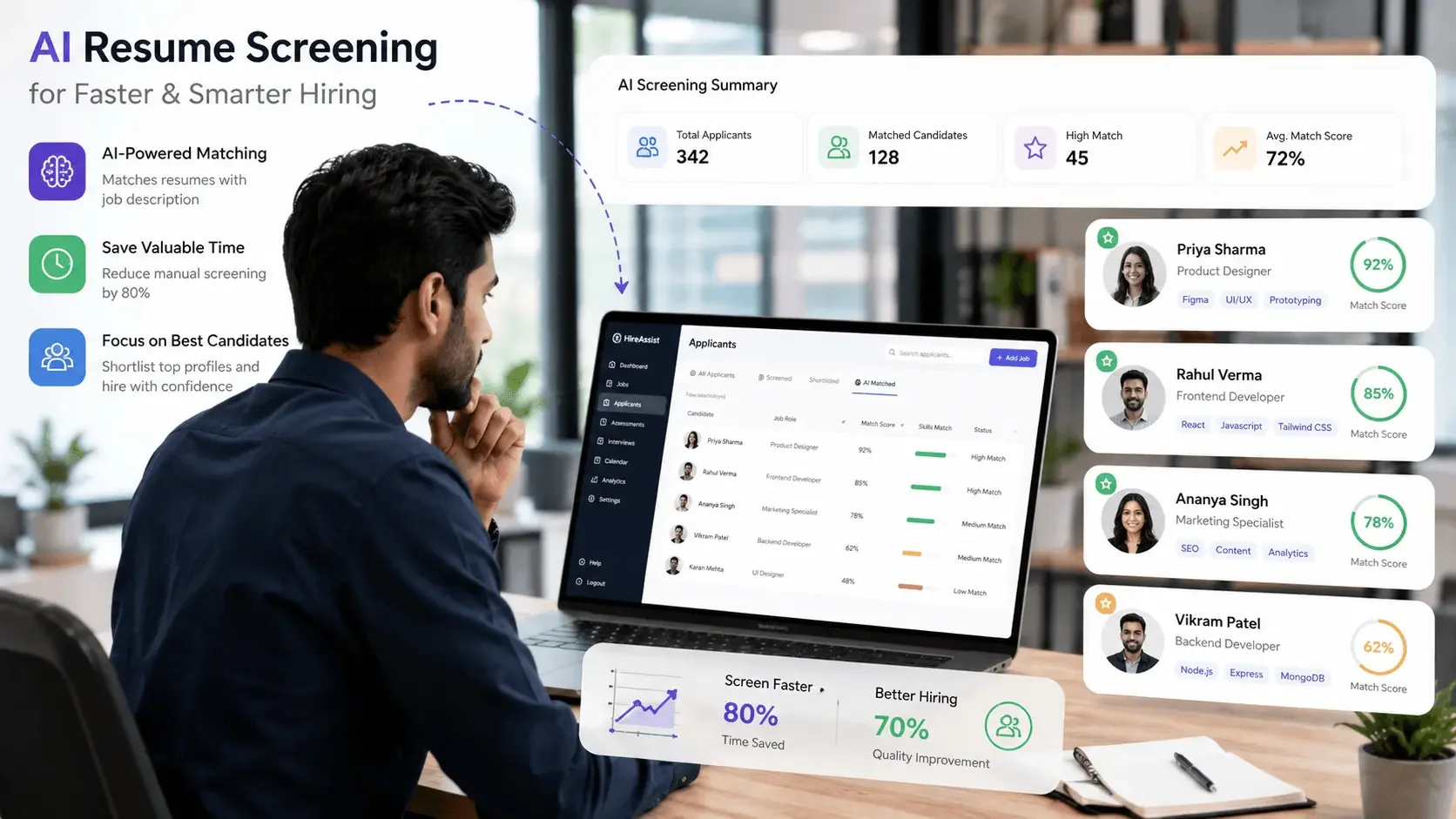
Recruitment technology can help hiring teams organize applications and reduce repetitive administrative work. Depending on the platform, recruiters may be able to track applications, search candidate profiles, compare qualifications, and manage communication from one place.
Some recruitment tools also provide resume matching or automated screening recommendations. These features can help recruiters prioritize applications, but they should not be treated as infallible decisions.
Automated systems may overlook relevant experience, interpret information incorrectly, or produce biased outcomes. Recruiters should review recommendations, check whether the evaluation criteria are job-related, and provide appropriate human oversight.
A recruitment platform such as HireAssist can support the broader hiring workflow through its available candidate management and evaluation features. Teams should verify which capabilities are supported by their particular configuration before relying on them.
What Common Resume Screening Mistakes Should Recruiters Avoid?
Even experienced recruiters can make mistakes when screening applications under time pressure.
- Relying only on job titles: Different organizations may use different titles for similar responsibilities.
- Overemphasizing exact keywords: Relevant skills may be described using alternative terminology.
- Using inconsistent standards: Applying different criteria to similar candidates can reduce fairness.
- Ignoring transferable skills: Experience from another role may still be relevant to the position.
- Rejecting candidates too quickly: A resume may require careful review to understand the candidate's actual contribution.
- Overlooking bias: Decisions should focus on job-related qualifications rather than personal characteristics unrelated to performance.
Avoiding these mistakes helps recruiters make more consistent and defensible screening decisions.
How Should Resume Screening Connect With Candidate Assessment?
Resume screening is only one stage of recruitment. A resume can indicate that a candidate has relevant experience, but it cannot always demonstrate how effectively the candidate performs a task.
After screening, recruiters may use structured interviews, technical tests, practical assignments, or role-specific assessments. For example, a quality assurance candidate might be asked to write test cases, identify defects in an application, or explain the difference between regression testing and retesting.
Assessment methods should reflect the responsibilities of the position. Candidates should also receive clear instructions about the next stage, expected timelines, and any assessment requirements.
What Metrics Can Help Measure Resume Screening Effectiveness?
Recruiters can use recruitment metrics to understand whether their screening process is working well.
Useful metrics include:
- Time to screen: The time required to review applications.
- Screening pass rate: The proportion of applicants who meet the initial requirements.
- Interview progression rate: The proportion of screened candidates who progress to interviews.
- Candidate withdrawal rate: The proportion of candidates who leave the process before completion.
- Quality of shortlisted candidates: Whether shortlisted applicants meet the role's requirements during later assessment stages.
Metrics should be interpreted carefully. A high screening pass rate does not automatically mean that screening is effective, and a low pass rate does not necessarily indicate a problem. Recruiters should consider the role, application volume, hiring outcomes, and fairness of the criteria together.
Frequently Asked Questions About Resume Screening
What is the main purpose of resume screening?
The main purpose of resume screening is to identify candidates whose qualifications, skills, and experience match the essential requirements of a job. It helps recruiters decide which applicants should progress to the next stage.
Can resume screening be automated?
Some screening activities can be supported by recruitment software, including application organization and resume matching. However, automated recommendations should be reviewed carefully by recruiters to check accuracy, relevance, and potential bias.
How long should resume screening take?
The time required depends on the number of applications, the complexity of the role, and the screening criteria. A clear checklist and organized workflow can reduce unnecessary delays while allowing recruiters to review applications carefully.
What should recruiters look for when screening resumes?
Recruiters should look for job-related skills, relevant experience, qualifications, certifications where required, project achievements, and evidence that the candidate can perform the essential responsibilities of the position.
How can recruiters make resume screening fairer?
Recruiters can improve fairness by defining clear criteria, applying the same standards to all candidates, documenting decisions, avoiding irrelevant personal assumptions, and regularly reviewing screening outcomes for potential bias.
Key Takeaways
- Resume screening helps recruiters identify applicants who meet essential job requirements.
- Clear criteria and consistent evaluation improve screening quality.
- Relevant projects and transferable skills should be considered alongside job titles.
- Recruitment technology can support screening but should not replace appropriate human review.
- Structured interviews and assessments help validate candidate suitability.
- Regularly reviewing screening metrics can help improve recruitment outcomes.
Conclusion
Resume screening is an essential part of an organized recruitment process. By defining job requirements, reviewing relevant qualifications, applying consistent criteria, and using recruitment technology responsibly, hiring teams can identify suitable candidates more efficiently.
The strongest screening process combines clear evaluation standards with thoughtful human judgment. Recruiters should continually review their methods, communicate clearly with applicants, and ensure that decisions remain focused on the actual requirements of the role.
For organizations improving their recruitment workflows, HireAssist can be explored as part of a broader approach to candidate management and evaluation. The goal is to create a hiring process that is organized, efficient, transparent, and focused on finding the right candidates.
https://hireassist.org/blog/beyond-the-resume-how-ai-helps-you-make-better-hiring-decisionsWhat Is Resume Screening? A Complete Guide for Recruiters
Resume screening is one of the most important steps in the recruitment process. It helps recruiters identify candidates whose qualifications, skills, and professional experience match the requirements of an open position. When organizations receive hundreds of applications, a structured resume screening process makes it easier to organize applications, evaluate candidates, and decide who should move to the next stage.
Recruiters need to consider more than job titles or keywords when reviewing applications. A candidate's practical experience, relevant projects, transferable skills, and achievements can provide valuable information about their suitability for a role. By following a consistent process, hiring teams can improve efficiency and make better-informed recruitment decisions.
What Is Resume Screening?
Resume screening is the process of reviewing candidate resumes to determine whether applicants meet the essential requirements of a job. Recruiters examine information such as education, work experience, technical skills, certifications, projects, and professional achievements.
For example, a company hiring a quality assurance engineer may look for candidates with knowledge of manual testing, test case creation, bug reporting, regression testing, and API testing. Recruiters compare these qualifications with the job description before deciding whether a candidate should progress.
The purpose of resume screening is not simply to reject applications quickly. Instead, it is to identify candidates who demonstrate relevant qualifications and potential for the position.
Why Is Resume Screening Important?
Resume screening helps hiring teams manage applications more efficiently. Without a structured approach, recruiters may spend too much time reviewing unsuitable profiles or overlook qualified candidates.
An effective resume screening process offers several benefits:
Saves time: Recruiters can prioritize applications that meet essential job requirements.
Improves consistency: A shared evaluation framework helps teams assess candidates using similar criteria.
Supports better decisions: Relevant qualifications and experience become easier to compare.
Organizes recruitment: Screening results help recruiters manage candidate progress.
Improves candidate experience: A clear process supports timely communication and defined next steps.
Although screening can improve recruitment efficiency, the quality of the results depends on how clearly the job requirements are defined and how consistently they are applied.
How Does Resume Screening Work?
A reliable resume screening process follows a series of steps. Organizations can adapt these steps according to the role, hiring volume, and recruitment requirements.
1. Define the Job Requirements
Start by reviewing the job description. Identify the essential qualifications, required skills, relevant experience, and main responsibilities.
Separate mandatory requirements from preferred qualifications. This distinction helps recruiters avoid rejecting suitable candidates because they lack a skill that is helpful but not essential.
2. Review Candidate Information
Read each resume to understand the candidate's background. Look for relevant work experience, educational qualifications, technical knowledge, certifications, and project experience.
Recruiters should consider the context of a candidate's achievements rather than relying only on job titles or the number of years worked.
3. Compare Skills With the Job Description
Compare the candidate's demonstrated skills with the requirements of the position. For a software developer, relevant skills might include programming languages, databases, and software development practices. For a recruiter, relevant experience might include sourcing, interviewing, and applicant tracking systems.
Use job-related criteria and apply them consistently to every application.
4. Identify Suitable Candidates
After reviewing the applications, identify candidates who meet the essential requirements. Record the reasons for screening decisions and move suitable candidates to the next stage, such as an interview or skills assessment.
5. Review and Improve the Process
Recruiters can track how many applicants pass screening, how long screening takes, and which criteria frequently exclude candidates. Reviewing this information can help teams improve future hiring processes.
What Are the Best Practices for Resume Screening?
Recruiters can improve screening quality by following practical and consistent methods.
Use a structured evaluation checklist. Create a checklist based on the job description so that each candidate is assessed against the same essential requirements.
Look beyond keywords. Candidates may describe similar skills using different terms. Review the meaning and context of their experience rather than relying exclusively on exact keyword matches.
Consider relevant projects. Projects can demonstrate practical knowledge, especially for fresh graduates and candidates with limited professional experience.
Document screening decisions. Keep clear, job-related notes explaining why candidates meet or do not meet essential requirements.
Protect candidate information. Handle resumes and personal information responsibly, following applicable privacy policies and data protection requirements.
Review criteria regularly. If many potentially suitable candidates are rejected, check whether the job requirements or screening criteria are unnecessarily restrictive.
How Can Recruitment Technology Improve Resume Screening?
Recruitment technology can help hiring teams organize applications and reduce repetitive administrative work. Depending on the platform, recruiters may be able to track applications, search candidate profiles, compare qualifications, and manage communication from one place.
Some recruitment tools also provide resume matching or automated screening recommendations. These features can help recruiters prioritize applications, but they should not be treated as infallible decisions.
Automated systems may overlook relevant experience, interpret information incorrectly, or produce biased outcomes. Recruiters should review recommendations, check whether the evaluation criteria are job-related, and provide appropriate human oversight.
A recruitment platform such as HireAssist can support the broader hiring workflow through its available candidate management and evaluation features. Teams should verify which capabilities are supported by their particular configuration before relying on them.
What Common Resume Screening Mistakes Should Recruiters Avoid?
Even experienced recruiters can make mistakes when screening applications under time pressure.
Relying only on job titles: Different organizations may use different titles for similar responsibilities.
Overemphasizing exact keywords: Relevant skills may be described using alternative terminology.
Using inconsistent standards: Applying different criteria to similar candidates can reduce fairness.
Ignoring transferable skills: Experience from another role may still be relevant to the position.
Rejecting candidates too quickly: A resume may require careful review to understand the candidate's actual contribution.
Overlooking bias: Decisions should focus on job-related qualifications rather than personal characteristics unrelated to performance.
Avoiding these mistakes helps recruiters make more consistent and defensible screening decisions.
How Should Resume Screening Connect With Candidate Assessment?
Resume screening is only one stage of recruitment. A resume can indicate that a candidate has relevant experience, but it cannot always demonstrate how effectively the candidate performs a task.
After screening, recruiters may use structured interviews, technical tests, practical assignments, or role-specific assessments. For example, a quality assurance candidate might be asked to write test cases, identify defects in an application, or explain the difference between regression testing and retesting.
Assessment methods should reflect the responsibilities of the position. Candidates should also receive clear instructions about the next stage, expected timelines, and any assessment requirements.
What Metrics Can Help Measure Resume Screening Effectiveness?
Recruiters can use recruitment metrics to understand whether their screening process is working well.
Useful metrics include:
Time to screen: The time required to review applications.
Screening pass rate: The proportion of applicants who meet the initial requirements.
Interview progression rate: The proportion of screened candidates who progress to interviews.
Candidate withdrawal rate: The proportion of candidates who leave the process before completion.
Quality of shortlisted candidates: Whether shortlisted applicants meet the role's requirements during later assessment stages.
Metrics should be interpreted carefully. A high screening pass rate does not automatically mean that screening is effective, and a low pass rate does not necessarily indicate a problem. Recruiters should consider the role, application volume, hiring outcomes, and fairness of the criteria together.
Frequently Asked Questions About Resume Screening
What is the main purpose of resume screening?
The main purpose of resume screening is to identify candidates whose qualifications, skills, and experience match the essential requirements of a job. It helps recruiters decide which applicants should progress to the next stage.
Can resume screening be automated?
Some screening activities can be supported by recruitment software, including application organization and resume matching. However, automated recommendations should be reviewed carefully by recruiters to check accuracy, relevance, and potential bias.
How long should resume screening take?
The time required depends on the number of applications, the complexity of the role, and the screening criteria. A clear checklist and organized workflow can reduce unnecessary delays while allowing recruiters to review applications carefully.
What should recruiters look for when screening resumes?
Recruiters should look for job-related skills, relevant experience, qualifications, certifications where required, project achievements, and evidence that the candidate can perform the essential responsibilities of the position.
How can recruiters make resume screening fairer?
Recruiters can improve fairness by defining clear criteria, applying the same standards to all candidates, documenting decisions, avoiding irrelevant personal assumptions, and regularly reviewing screening outcomes for potential bias.
Key Takeaways
Resume screening helps recruiters identify applicants who meet essential job requirements.
Clear criteria and consistent evaluation improve screening quality.
Relevant projects and transferable skills should be considered alongside job titles.
Recruitment technology can support screening but should not replace appropriate human review.
Structured interviews and assessments help validate candidate suitability.
Regularly reviewing screening metrics can help improve recruitment outcomes.
Conclusion
Resume screening is an essential part of an organized recruitment process. By defining job requirements, reviewing relevant qualifications, applying consistent criteria, and using recruitment technology responsibly, hiring teams can identify suitable candidates more efficiently.
The strongest screening process combines clear evaluation standards with thoughtful human judgment. Recruiters should continually review their methods, communicate clearly with applicants, and ensure that decisions remain focused on the actual requirements of the role.
For organizations improving their recruitment workflows, HireAssist can be explored as part of a broader approach to candidate management and evaluation. The goal is to create a hiring process that is organized, efficient, transparent, and focused on finding the right candidates.