On October 1, LinkedIn announced Hiring Assistant 2, the next version of its AI agent for recruiters. It adds what LinkedIn calls more advanced reasoning, memory and personalization, pulls more candidate signals into one place, and can help manage an entire talent pool without switching systems. For global customers already using Hiring Assistant in English, LinkedIn says it starts updating automatically, for free, from November.
The feature list is interesting. The problem LinkedIn opens with is more interesting, because it's one most recruiters will recognize: it's getting harder to tell who's real.
The numbers LinkedIn is pointing at
LinkedIn's announcement leans on its own research and platform data. Here's what it reports:
- Global hiring is down 30% and applications per applicant are up 30% compared to pre-pandemic levels.
- 64% of US talent acquisition professionals say it's becoming harder to know who to trust and what's real when assessing candidates.
- 39% say their top challenge is not knowing if a candidate or their skills are real.
- 30% say speed is their top challenge, and almost 50% say they spend too much time switching between platforms.
The survey numbers come from August 2026 research by Censuswide for LinkedIn, among 500 US recruiters and talent acquisition professionals and 500 US C-suite executives at companies with 200+ employees. So they're US-focused and company-size specific. Worth keeping in mind if you're hiring for a ten-person team in Bengaluru.
Still, the pattern makes sense. AI makes it easy to apply to lots of jobs, so recruiters get more applications, and more of them look polished. Volume goes up and signal goes down.
What Hiring Assistant 2 changes
LinkedIn describes three areas.
It learns how you hire. With memory and personalization, the assistant is meant to understand hiring "from role-level to recruiter-level," so recommendations reflect how a specific recruiter actually works.
More signals in one place. New and improved signals include whether a candidate is verified, ATS insights, pre-screening responses and relevant work experience. LinkedIn members can also use connected apps to show their capabilities on their profile.
Managing the whole talent pool. Hiring Assistant 2 can help manage an entire talent pool in one place, which goes straight at the platform-switching complaint.
LinkedIn also shares results for the current Hiring Assistant. It says more than 20,000 companies are using its agentic hiring solutions in the first year of general availability. It reports that recruiters are 4x more likely to contact candidates sourced by Hiring Assistant than those found through traditional methods, that recruiters review 83% fewer profiles to find qualified matches, and that its prescreening is completed in a median of 6 minutes, compared with the 3.5 hours it says it typically takes a recruiter to give a first response. These are LinkedIn's own figures about its own product, so treat them as the vendor's claims.
Faster isn't the same as better
Here's where I'd push back a little, not on the product but on how teams will be tempted to use it.
Look at what the tool optimizes for: fewer profiles reviewed, faster prescreening, candidates the recruiter is more likely to contact. All useful. But none of those is "we hired the right person." A shortlist you reach faster is only better if the criteria behind it are right.
That's the part an AI agent can't fix for you. If your team hasn't agreed what good looks like for the role, the assistant will learn your habits, including the bad ones. "Personalized to the recruiter" cuts both ways. It'll get very good at finding people who look like the people you've always picked.
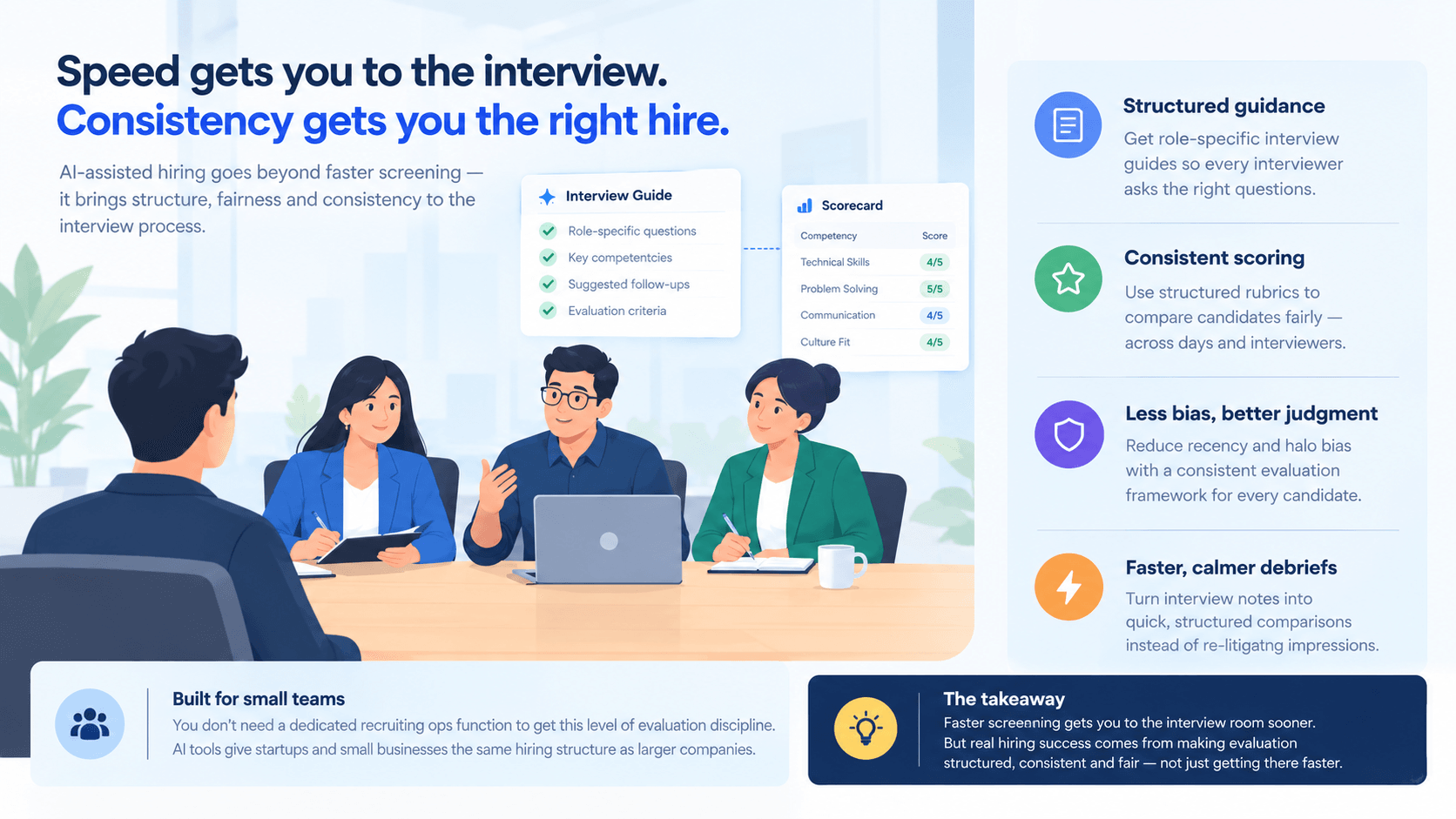
We've argued before that you should write the scorecard before the interview. It matters even more now. Write down the three or four things the role actually needs before you turn an agent loose on the talent pool, and check its recommendations against that list, not against your gut.
The verification signals are the real story
Of everything in the release, the verification and skills signals are what I'd pay the most attention to. LinkedIn's own data says recruiters are struggling with trust, and "is this person verified" plus "did they actually do this work" is exactly what's been missing.
But a signal is an input, not a verdict. A verified identity tells you the person is who they say they are. It doesn't tell you they can do the job. A polished pre-screening answer could have been written with AI. ATS history tells you what happened in your process, not why.
So I'd treat verification as a floor, not a filter. Use it to screen out fakes. Then do the work that only people can do: a real conversation, a work sample that matches the job, and reference calls that ask about the bad month, not just the highlights.
What small teams should do now
If you're not a big LinkedIn Recruiter customer, you won't get Hiring Assistant 2 in November. But the problem it's built for will reach you anyway. A few things worth doing regardless of your tools:
- Ask for one small proof of skill early. A short, paid or very brief task tied to the actual job. It cuts through polished applications better than any profile.
- Write your criteria before you look at applicants. Every AI screener, LinkedIn's or anyone else's, works better when you know what you're screening for.
- Keep a human on the final shortlist. Let the tool narrow the pile. Have a person read every resume on the shortlist before anyone books an interview.
- Tell candidates where AI is used. If an agent is prescreening them, say so. People handle it fine when it's out in the open.
My take
Hiring Assistant 2 is a sensible response to a real problem, and the move toward verification and skills signals is the right one. I'd use it if it's available to you.
Just don't confuse faster with better. The tool can help you look at fewer profiles and respond sooner, and candidates will appreciate the faster response. Deciding who's actually good for the role, and whether the evidence is real, is still the recruiter's job. If anything, it's the bigger part of the job now that applying has become so easy.